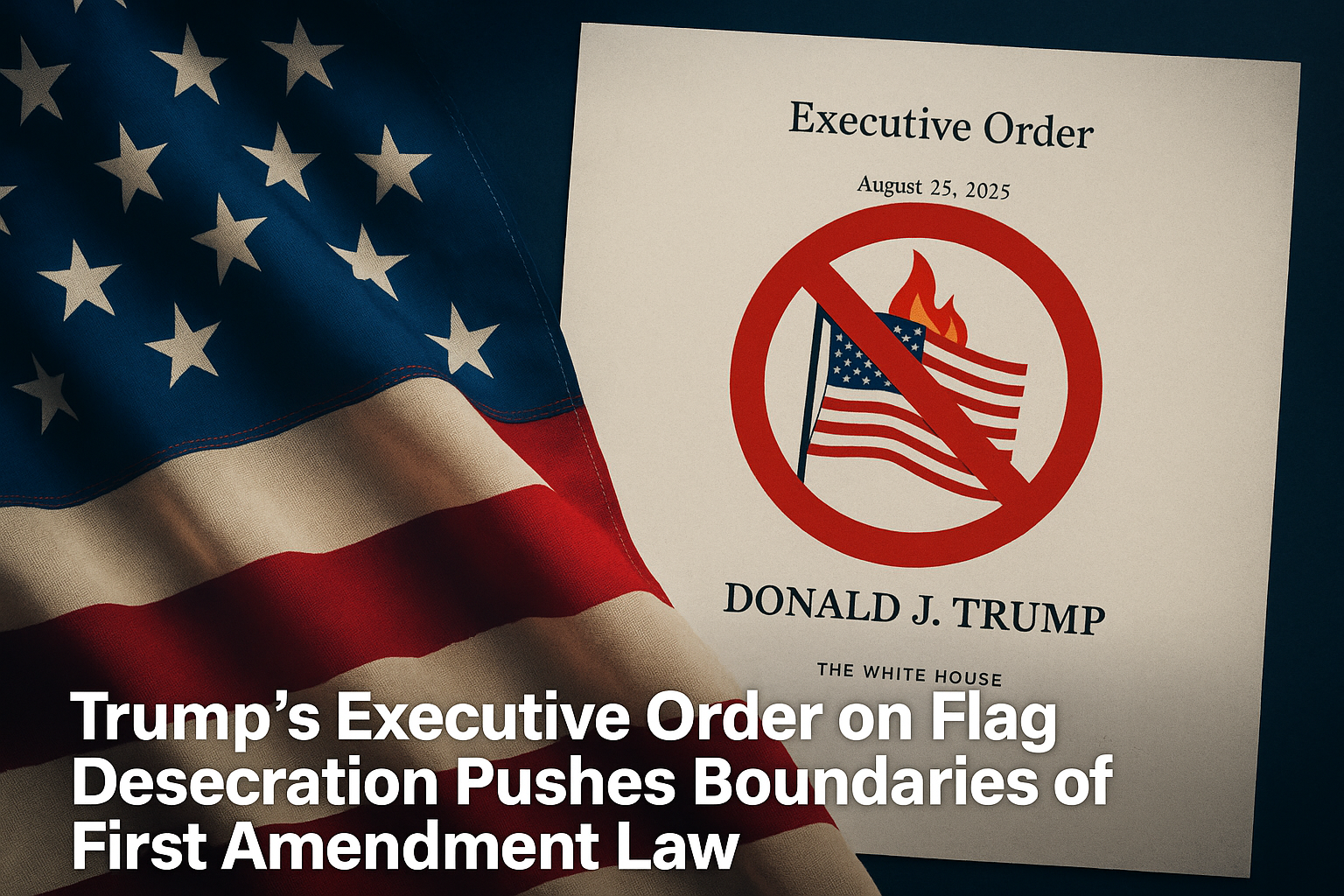
WASHINGTON — President Donald Trump signed an executive order on Aug. 25 directing the Justice Department and other federal agencies to pursue cases of flag desecration more aggressively, igniting fresh debate over the balance between patriotism and free expression in America.
The order frames the American flag as the nation’s most sacred symbol and instructs federal prosecutors to target cases where flag burning is tied to violent acts, hate crimes, property destruction, or threats against U.S. citizens.
It also allows agencies to refer cases to state and local governments when existing laws, such as fire codes or disorderly conduct ordinances, could apply.
Additionally, the directive expands the scope of enforcement beyond U.S. citizens.
Federal agencies, including the Departments of State, Justice, and Homeland Security, are authorized to deny or revoke visas, block naturalization, or remove foreign nationals found to have engaged in flag desecration under certain circumstances.
The move marks a direct challenge to the constitutional guardrails established by the Supreme Court.
In Texas v. Johnson (1989), justices ruled that flag burning constitutes symbolic speech protected by the First Amendment.
The decision, reaffirmed in United States v. Eichman (1990), invalidated both state and federal laws that sought to criminalize flag desecration on the grounds that the government cannot prohibit expression simply because it is offensive.
Trump’s order acknowledges these rulings but argues that the Court has never explicitly protected acts of desecration when they incite imminent violence or constitute “fighting words.”
By emphasizing these exceptions, the administration is attempting to carve out a legal pathway that could withstand constitutional scrutiny.
Critics, however, contend that the order invites legal challenges and could ultimately return the question of flag burning to the Supreme Court.
Any enforcement based on the new directive is expected to be closely watched by civil liberties groups and could test the durability of First Amendment protections first defined more than three decades ago.
For now, the executive order stands as both a symbolic affirmation of national pride and a legal gamble that may force the highest court in the land to reconsider the boundaries of free expression.
About the Author