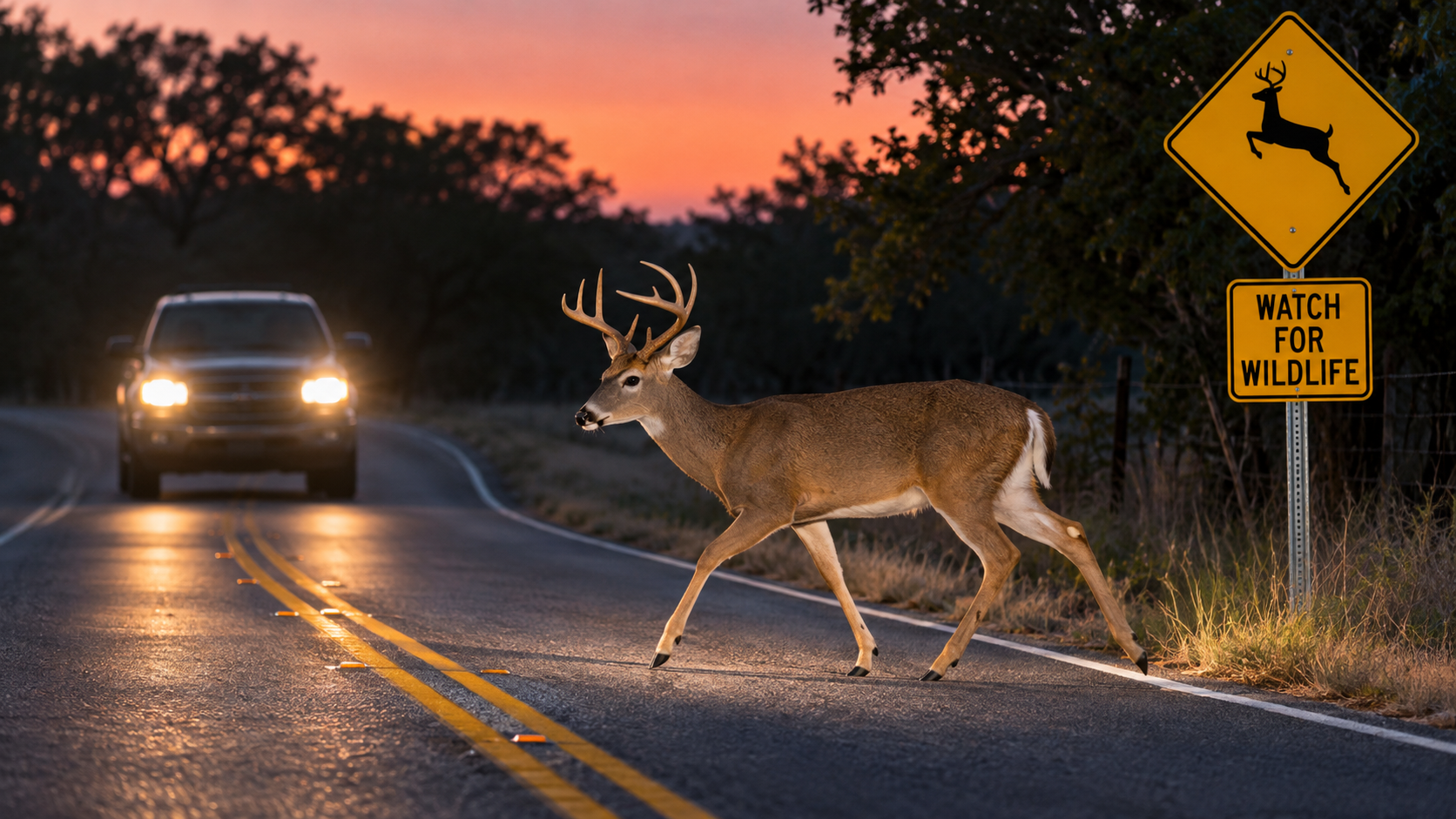
AUSTIN, Texas — As daylight saving time ended Sunday, Nov. 1, wildlife advocates urged Texas motorists to remain alert for animals crossing roadways as darker evening commutes coincide with deer breeding season.
Clocks moved back one hour at 2 a.m., shifting sunset earlier and placing more commuters on roads after dark.
According to the Texas Department of Transportation, 7,041 vehicle units were involved in reported crashes in 2025 in which a wild animal on the roadway was listed as a contributing factor.

That included 5,823 in rural areas and 1,218 in urban areas. The figures count vehicle units, not individual crashes.
Nationwide, the Federal Highway Administration estimates more than 1 million wildlife-vehicle collisions occur annually.
The Texas Parks and Wildlife Department estimates the state’s white-tailed deer population at 5.64 million. Deer activity typically increases during the fall mating season, particularly around dawn and dusk.
“For some species, a wildlife crossing means the difference between life or death,” said Sharon Wilcox, senior Texas representative for Defenders of Wildlife. “Crossings give wildlife a safe way to travel between habitat and reduce on-road deaths and help to protect drivers, too, because every animal that crosses safely is one less hazard on the roadway. Every driver can play a part by slowing down, keeping an eye out for wildlife and advocating for safer roads for all of us.”
Beyond the dangers to motorists, wildlife advocates are raising concerns about Texas’ endangered ocelots. Federal wildlife officials estimate fewer than 100 ocelots remain in two isolated breeding populations in South Texas.
“Vehicle collisions have been an unrelenting threat to ocelots for decades. In the past 20 years, most documented ocelot deaths in Texas occurred on roadways,” Wilcox said. “A wild ocelot in Texas has a higher chance of dying in a collision with a vehicle than from any other threat it faces. With a population this small, every loss is a blow to the species’ recovery. And every collision puts the people in the car at risk, too.”
A study of one South Texas ocelot population found vehicle collisions accounted for 40% of known deaths from 1982 to 2001.
That research does not establish that most ocelot deaths statewide occurred on roads during the past 20 years.
TxDOT advises drivers to reduce speed, watch for multiple deer, use high-beam headlights when appropriate and avoid swerving when an animal enters the roadway.
About the Author